Humanitarian justice must include how we spend
Every humanitarian budget has two levels of impact: what the programme achieves, and what its spending makes possible. We have become increasingly sophisticated at planning and evaluating the first. We give far less attention to the second, even though it represents an enormous opportunity for livelihoods, resilience and justice.
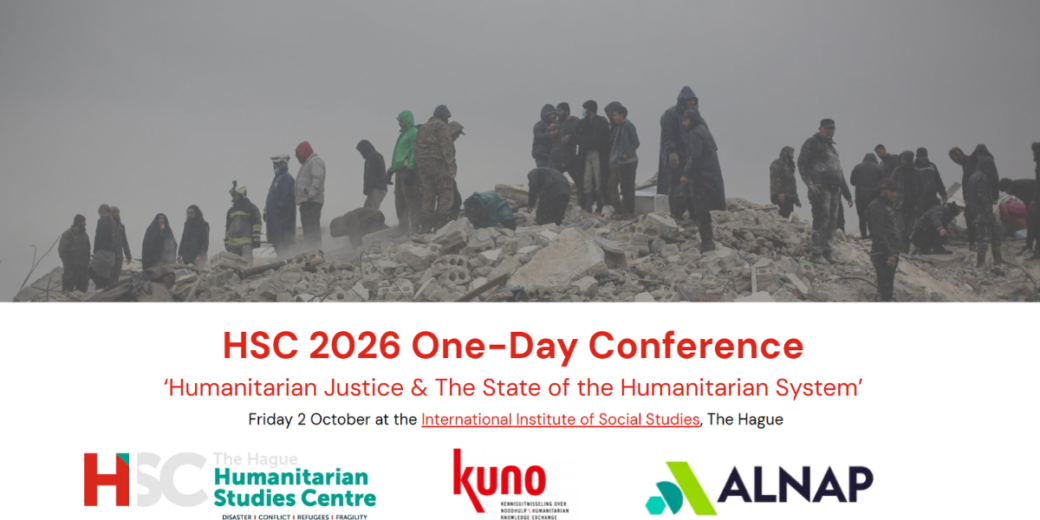
On 2 October, I presented “Localising the back office: Procurement infrastructure as humanitarian justice” (with Mawared MENA as case study) at the Humanitarian Studies Centre’s conference in The Hague, organised in partnership with ALNAP and KUNO. The conference brought the State of the Humanitarian System 2026 into conversation with humanitarian justice, asking how our sector should respond to the pressures it faces and what meaningful reform requires. My contribution started from a practical conviction: supply chains, logistics and procurement are key levers for change. Treating them as back-office or administrative functions overlooks their influence over both the delivery of assistance and what remains afterwards. In these deeply challenging years for humanitarian action, we can no longer afford to overlook that influence.
Two levels of impact: programme impact and spending impact
A programme provides sanitation, runs a clinic or delivers shelter. To do so, organisations purchase materials, equipment, transport and services. Every contract creates an opportunity for a supplier. Those decisions influence where income goes, which businesses can invest, whose work is sustained, and where knowledge and capabilities accumulate. I call these programme impact and spending impact. The same money produces both. Humanitarian reform needs to take responsibility for both.
Humanitarian supply chains: a $2 billion opportunity in Syria
Consider the scale. The OCHA Financial Tracking Service figures consulted for my presentation recorded approximately US$2.7 billion in humanitarian funding for Syria in 2025, including funding inside and outside coordinated appeals (United Nations Office for the Coordination of Humanitarian Affairs [OCHA], n.d.). Supply chains are commonly estimated to account for 60–80% of humanitarian response costs. An empirical analysis across 20 humanitarian operations found a share of 74%, confirming the scale of this opportunity (European Commission, n.d.; Stumpf et al., 2023). Applying that broad range suggests roughly US$1.6–2.2 billion. Around US$2 billion moving through supply chains. This is an illustration of scale, rather than measured Syrian supply-chain expenditure. It does not tell us how much could realistically be sourced locally. But it makes clear why the consequences of those purchasing decisions deserve serious attention.
This expenditure represents demand, contracts, income and employment. How deliberately are we using it to sustain the capabilities that communities will continue to need?
What does humanitarian justice require from our spending?
The Istanbul–Bergen Declaration on Humanitarian Justice calls for responses that address immediate suffering alongside deeper systemic injustices. It recognises community leadership and demands accountability from those holding power (Humanitarian Studies Centre, 2025). That commitment must reach into the way humanitarian money is spent. Hilhorst and colleagues (2025) argue that localisation should recognise that “power must be restored to where it belongs, with the people that experience the crisis that needs relieving”. Procurement offers a concrete place to act on that principle. Purchasing decisions distribute economic opportunity every day, and the rules surrounding them determine who has a realistic chance to participate.
Research co-authored by Harwin de Vries already examines why localisation commitments translate so slowly into the operational realities of procurement, warehousing and transport. It identifies organisational incentives, external expectations and resistance to change among the barriers (Frennesson et al., 2022). We should bring these conversations together. The scholarship on humanitarian power and justice asks whose interests count. Supply-chain research examines how operational decisions work. Connecting them can help us understand how spending affects delivery, livelihoods and people’s ability to shape their futures.
Local procurement, livelihoods and lasting resilience
Nancy Fraser’s (2008) framework provides a useful lens: justice involves redistribution, recognition and representation. Applied to humanitarian purchasing, this means examining who receives contracts and income, whose existing capabilities are recognised, and who influences the decisions. A supplier’s address alone cannot answer those questions. Ownership, employment, working conditions and local production matter too.
In Gaza, for example, we should ask whether purchasing supports Palestinian-owned businesses, Palestinian employment and Palestinian productive capacity, wherever safe delivery and market conditions permit. Palestinian industry and chamber-of-commerce assessments, published through UNDP, offer an important starting point because they incorporate businesses’ own perspectives on recovery (United Nations Development Programme [UNDP], 2024). Procurement cannot remove the destruction and restrictions confronting the Palestinian economy. But the decisions within our reach should support Palestinians’ ability to sustain livelihoods and shape recovery.
Women-owned and women-led small businesses offer another example. The African Development Bank and African Union Commission’s (2024) Africa Gender Index report cites research indicating that women reinvest up to 90% of their incomes in areas such as education, health and community activities. That figure should not be transferred indiscriminately across countries and contexts. It does illustrate why economic opportunity can have consequences well beyond the business receiving it. Women’s access to income and economic agency also matters in its own right.
Are our purchasing processes designed to make that access possible? Or do contract sizes, documentation requirements and payment terms repeatedly favour those who already have the resources to participate? Local purchasing does not automatically produce justice. We need to bring our expectations into spending decisions: fair working conditions, non-discrimination, responsible environmental practices and meaningful access for smaller suppliers. Requirements must be proportionate, with support to meet them, otherwise standards intended to improve outcomes can become another barrier.
Donors and researchers: make spending impact a priority
Resilience also needs to be understood carefully. Hilhorst (2018) warns that recognising people’s capabilities can slide into expecting them to manage their own survival while external responsibilities retreat. My argument asks humanitarian actors to take greater responsibility for the resources they control: to spend in ways that sustain existing capabilities and broaden opportunity.
Donors can begin now. They can examine whether funding rules enable local participation, resource procurement properly, and expect organisations to consider spending impact alongside programme outcomes. This requires practical support. Another reporting obligation without the means to act will achieve little.
Researchers can connect existing supply-chain scholarship with humanitarian justice research, informing both directions. We need evidence about which purchasing practices improve delivery, widen participation and sustain livelihoods and which reproduce exclusion or undermine markets. That research should involve affected communities, local organisations, workers and businesses in setting the questions.
The opportunity to begin is already within our reach. Contract sizes, payment terms, supplier searches and purchasing criteria are decisions being made today. We can change practices, assess their consequences and build evidence together.
Urgency remains essential. People need timely, safe and effective assistance. Considering spending impact belongs within the decisions required to deliver that assistance. In protracted crises, where purchasing continues year after year, those decisions become a sustained economic presence whose effects accumulate. This is why I feel so strongly about bringing supply chains into the centre of humanitarian reform. We already have substantial resources moving through them. We already make the decisions. The second level of impact already happens.
It is time to make it intentional and to judge humanitarian success by both what we deliver and what our spending leaves behind.
Resources
- African Development Bank & African Union Commission. (2024). Africa Gender Index 2023: Analytical report. Read the report.
- European Commission. (n.d.). Strategic supply chain. Directorate-General for European Civil Protection and Humanitarian Aid Operations. Read the overview.
- Fraser, N. (2008). Scales of justice: Reimagining political space in a globalizing world. Columbia University Press. Publisher’s page.
- Frennesson, L., Kembro, J., de Vries, H., Jahre, M., & Van Wassenhove, L. N. (2022). International humanitarian organizations’ perspectives on localization efforts. International Journal of Disaster Risk Reduction, 83, Article 103410. https://doi.org/10.1016/j.ijdrr.2022.103410.
- Hilhorst, D. (2018). Classical humanitarianism and resilience humanitarianism: Making sense of two brands of humanitarian action. Journal of International Humanitarian Action, 3, Article 15. https://doi.org/10.1186/s41018-018-0043-6.
- Hilhorst, D., Alburo-Cañete, K. Z., Aparicio, J. R., Kyamusugulwa, P. M., & Woldetsadik, T. K. (2025). Humanitarian observatories: Insights for reforming humanitarianism from below. Journal of International Humanitarian Action, 10, Article 10. https://doi.org/10.1186/s41018-025-00172-1.
- Humanitarian Studies Centre. (2025). Istanbul–Bergen declaration on humanitarian justice. Read the declaration and its background.
- Humanitarian Studies Centre. (2026). HSC 2026 one-day conference: Humanitarian justice & the state of the humanitarian system. Conference page.
- Stumpf, J., Besiou, M., & Wakolbinger, T. (2023). Assessing the value of supply chain management in the humanitarian context – An evidence-based research approach. Journal of Humanitarian Logistics and Supply Chain Management, 13(1), 1–9. https://doi.org/10.1108/JHLSCM-03-2022-0039
- United Nations Development Programme. (2024, October 14). Gaza insights: Impact of the Gaza war on private sector and pathways for recovery. Read the publication.
- United Nations Office for the Coordination of Humanitarian Affairs. (n.d.). Syrian Arab Republic 2025: Funding summary. Financial Tracking Service. View the dashboard. Figures reflect the snapshot consulted for the presentation; the dashboard is updated over time.
Related thinking
We can create the world we want to see
Markets are not neutral. They reward what we design them to reward and determine whether capital strengthens resilience, inclusion and local economies.
After the grant: the missing infrastructure between impact money and local markets
Why funding is only the beginning and how spending decisions determine what impact money ultimately builds.
Procurement isn’t boring. It’s powerful.
How everyday purchasing decisions can become a lever for localisation, sustainability and systemic change.